
When God Calls It Sin – Part 1 – #1 Ordinary Saints

About this Series: “When God Calls It Sin” was originally a 5-week study I had lead in 2019 for an adult Sunday School class at my old church.
The outlines and lessons were based on Jerry Bridges’ book “Respectable Sins,” which I highly recommended for anyone serious about confronting the sins in their own hearts that are often overlooked.
For the blog, I am adapting my own notes and slides from the class and posting them almost verbatim. Since each class was an hour long, however, I will be dividing segments of each lesson into separate posts for easier reading.
Jump To:
- Part 1 (Introduction)
- Part 2 (Ungodliness || Unthankfulness || Anxiety || Frustration || Discontentment)
- Part 3 (Pride || Selfishness || Judgmentalism)
- Part 4 (Anger || Impatience & Irritability || Envy, Jealousy, & Related Sins)
- Part 5 (Sins of the Tongue || Wordliness)
Part 1 Segments:
- > Ordinary Saints
- The Disappearance of Sin
- The Malignancy of Sin
- The Remedy of Sin
- The Power of the Holy Spirit / Conclusion
Ordinary Saints
Before we can begin taking a closer look at what God calls “sin” and how we tend to tolerate or excuse them in our own lives, we need to lay some foundations and define a couple of terms first.
Let’s begin by reading 1 Corinthians 5:1-2:
It is actually reported that there is sexual immorality among you, and sexual immorality of such a kind as does not exist even among the Gentiles, that someone has his father’s wife. And you have become puffed up and have not mourned instead, so that the one who had done this deed would be removed from your midst.
1 Corinthians 5:1-2 LSB
What we really need to notice here is that the church in Corinth had a very serious sin problem. They were behaving so immorally that even the godless pagans around them would look on with disgust. And yet, if you were to flip back to the first chapter, you will also see that the Apostle Paul refers to the Corinthians as “saints.”
Could this possibly be the same church? How could Paul refer to the Christians at Corinth as “saints” when they were so proud and boastful of their own sexual immorality?
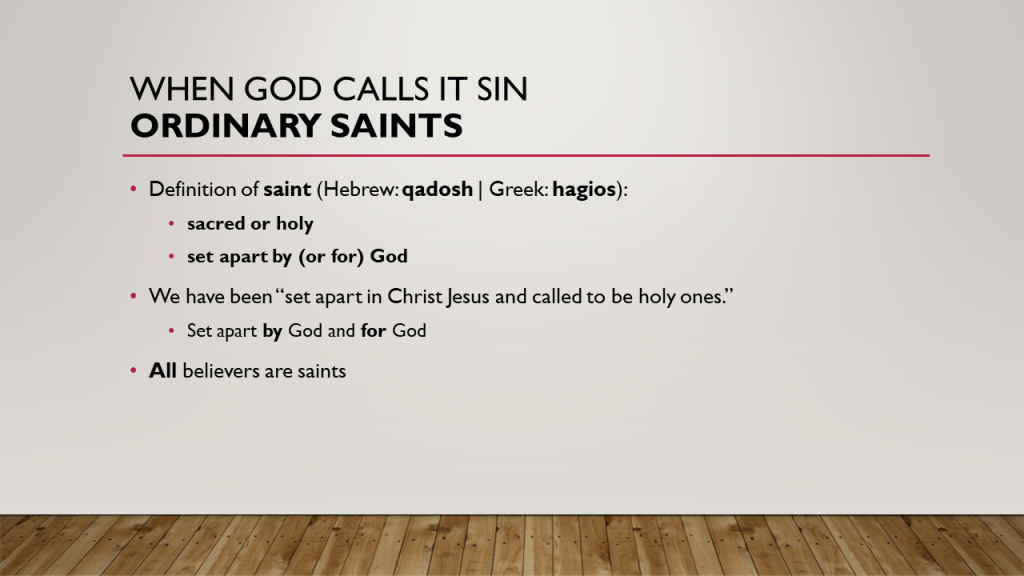
To answer that question, we need to look at the definition of the word “saint,” as found in Scripture (Hebrew: qadosh | Greek: hagios).
Today, the word has lost much of its original meaning and is usually reserved for those “sainted” by the Roman Catholic Church, including most of the original Apostles, and tender old grandmothers who would never hurt a fly.
However, in both the Old and New Testaments, the word translated as “saint” in English means to be “sacred” or “set apart,” either by God, for God, or both.
Paul tells us in 1 Corinthians 1:2 that we, as Christians, “have been sanctified in Christ Jesus, called as saints…” In other words, we have been “set apart in Christ Jesus and called to be holy ones.” (JB)
Therefore, if you are a Christian, having repented of your sins and placed your faith in Jesus Christ and in Him alone, you have been set apart for God and now have a new identity: you are now a saint. We do not need to clean ourselves up or be fully sanctified in order to be a saint. Look at what Paul tells us just a few verses later in chapter 5:
Clean out the old leaven so that you may be a new lump, just as you are in fact unleavened.
1 Corinthians 5:7a LSB (emphasis added)
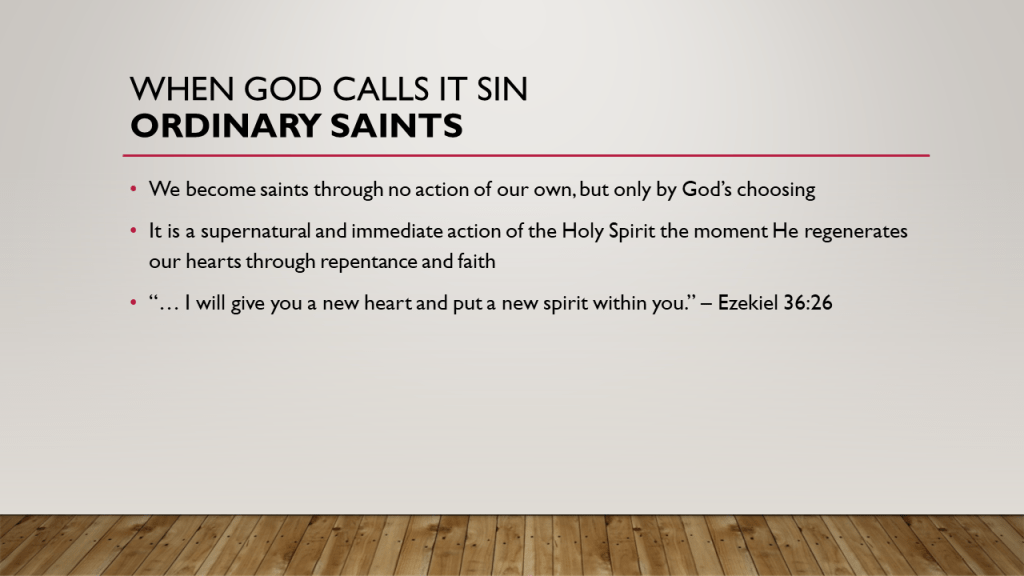
He is telling the Corinthians to clean up their act because they are saints, not in order to become saints! We cannot attain sainthood through any actions of our own; it is an immediate and supernatural work of the Holy Spirit that takes place the moment He regenerates our hearts through repentance and faith!
Ezekiel 36:26 describes the Spirit’s work like this:
Moreover, I will give you a new heart and put a new spirit within you; and I will remove the heart of stone from your flesh and give you a heart of flesh.
Ezekiel 36:26 LSB
So, we become saints through God’s choosing and His alone. We receive a new heart, with new Godly desires and truly do become a new creation (2 Corinthians 5:7).
However, there is a disconnect or a tension here because, obviously, we all do still sin. In fact, Paul spends most of the rest of 1 Corinthians telling the church that because they are saints, they need to start acting like it! The Corinthians were not living according to their calling as saints.
If you have ever heard the military expression “conduct unbecoming an officer,” then you have a general idea of the principle at work here. Just as the military would chastise its leaders for behavior which was not consistent with what the military expects of their officers, we as Christians run the same risk.
When we gossip, or are impatient, or get unjustly angry, we need to remind ourselves that our own conduct is unbecoming a saint. Like the Corinthians, I suspect many of us are acting inconsistently with our calling.
That ought not to be!
In the Bible, “conduct unbecoming a saint” is also called “sin” and it covers a depressingly wide range of behaviors.

Next: The Disappearance of Sin >>
 The Unworthy Prodigal
Pingback: When God Calls It Sin – Part 2 – #4 Frustration & Discontentment – The Unworthy Prodigal
Pingback: When God Calls It Sin – Part 1 – #2 The Disappearance of Sin – The Unworthy Prodigal
Pingback: When God Calls It Sin – Part 1 – #3 The Malignancy of Sin – The Unworthy Prodigal
Pingback: When God Calls It Sin – Part 1 – #4 The Remedy of Sin – The Unworthy Prodigal
Pingback: When God Calls It Sin – Part 1 – #5 The Power of the Holy Spirit – The Unworthy Prodigal